The Truth Pill: the Myth of Drug Regulation in India by Dinesh Singh Thakur
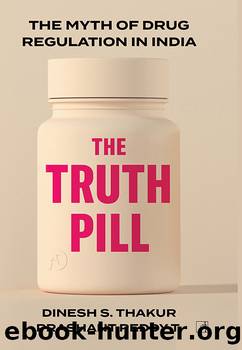
Author:Dinesh Singh Thakur
Language: eng
Format: epub
Publisher: S&S India
Published: 2022-01-15T00:00:00+00:00
CHAPTER SEVEN
The Losing Battle to Regulate Traditional Indian Medicine
At the height of the first wave of the Covid-19 pandemic in India in the year 2020, the Indian media aired a most extraordinary press conference by the yoga-guru-turnedentrepreneur, Baba Ramdev, in his avatar as the founder of Patanjali Ayurved, a company that shot to fame for its herbal, ayurvedic and swadeshi products ranging from toothpaste to ayurvedic âcuresâ. At the press conference, Ramdev proclaimed to the world the discovery of an Ayurvedic remedy, Coronil, that had apparently proved its âeffectivenessâ in treating Covid-19 during âclinical trialsâ. In the ensuing publicity campaign, Patanjali claimed to the press that Coronil had proven 100% effective during clinical trials conducted at its facilities.1
At any other time, for any other disease, Ramdev could have made a similar claim and escaped with minimal scrutiny. However, to make such a claim at the height of a pandemic that was claiming thousands of lives daily, especially when the worldâs best scientific minds were struggling to find a cure for Covid-19, was pushing the boundaries of credulity of even the otherwise gullible Indian population. Initially, the Government of India and various state governments, which were already dealing with the fallout of the pandemic and its mounting death toll, made feeble attempts to restrain Ramdev from making such outlandish claims, only to settle for him marketing his âcureâ as an âimmunity boosterâ.2 In the later days of the pandemic, the Minister of Health and Family Welfare, Harsh Vardhan, appeared alongside Baba Ramdev as the latter released the results of the âclinical trialâ of Coronil.3 The Indian Medical Association and other groups of doctors lashed out at the Minister for endorsing what they described as an âunscientific productâ.4 Nevertheless, sales of Coronil were reportedly well in the range of â¹250 crores by early November 2020, just as the first wave of the pandemic began to ebb.5
This entire fiasco was the result of policies actively peddled by the Government of India since independence to validate Ayurveda by attempting to mimic the language and techniques of modern medicine without paying heed to the scientific temperament or intellectual rigour that underlies the development of modern medicine. These attempts to establish the viability of traditional medicine, especially Ayurveda, in face of the steady popularity of modern medicine dates back to the time around Indiaâs independence from the British when India had to make several important decisions between the traditional and the modern in different areas ranging from the ideological foundations of its Constitution to its economy. More often than not, Indian policymakers tried to balance the demands of various interest groups by retaining elements of the traditional to placate the conservative elements within the society, while also pushing ahead with modernization. In the context of medicine, this struggle between the traditional and modern manifested itself in debates between the practitioners of traditional medicine and modern medicine, which by the time of independence from the British had already taken firm roots in India.
This debate over a ânational
Download
This site does not store any files on its server. We only index and link to content provided by other sites. Please contact the content providers to delete copyright contents if any and email us, we'll remove relevant links or contents immediately.
The Thirst by Nesbo Jo(7018)
Permanent Record by Edward Snowden(5908)
The Myth of the Strong Leader by Archie Brown(5553)
Spare by Prince Harry The Duke of Sussex(5267)
A Higher Loyalty: Truth, Lies, and Leadership by James Comey(5021)
Secrecy World by Jake Bernstein(4807)
Adulting by Kelly Williams Brown(4624)
The Borden Murders by Sarah Miller(4390)
Machine Learning at Scale with H2O by Gregory Keys | David Whiting(4379)
Killers of the Flower Moon by David Grann(4118)
American Kingpin by Nick Bilton(3936)
The Secret Barrister by The Secret Barrister(3758)
Fear by Bob Woodward(3724)
Future Crimes by Marc Goodman(3634)
The Last Girl by Nadia Murad(3551)
The House on Mango Street by Sandra Cisneros(3516)
Liar's Poker by Michael Lewis(3500)
Oathbringer (The Stormlight Archive, Book 3) by Brandon Sanderson(3320)
The Social Psychology of Inequality by Unknown(3092)
